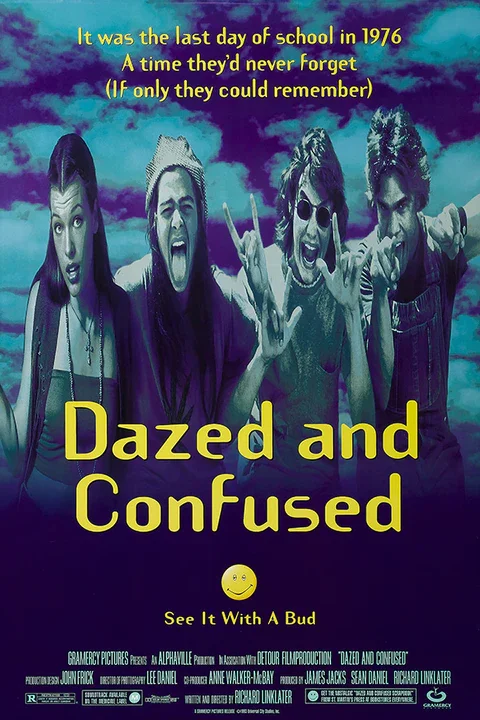
Dazed and Confused
(Richard Linklater, 1993)
⭐️⭐️⭐️⭐️⭐️

Last Day of School
May 28th, 1976
1:05 P.M.
If a machine existed to transport people inside the world of any movie of their choice, I would want to be placed in the halls of the fictional Lee High School in Austin, Texas at 1:05 P.M. in the year 1976. I don’t want to fly the Millennium Falcon. I don’t even want to traverse the caverns under the Lighthouse Lounge to find the Inferno and One Eyed Willy’s treasure. I want to transport to the moment the movie “Dazed and Confused” begins. I don’t even need to be a main character. It would perfectly be fine to get a bite at Top Notch, hang in the background at The Emporium, and enjoy the vibes of this one particular night in Texas before things move to The Moon Tower and “Tuesday’s Gone” by Lynyrd Skynyrd closes out the night.
I first watched “Dazed and Confused” when I was in middle school, too young to fully grasp what the movie was saying. I just liked that the character said a lot of cuss words, and I was seeing an R rated movie when I shouldn’t have been seeing an R rated movie. I didn’t watch the movie again until I was in high school, and I was able to appreciate it for what it really was. Even for a movie set in 1976, there was something timeless about what the characters were doing and experiencing. I grew up in a somewhat small suburb of a larger town (Pinson, Alabama as a suburb of Birmingham, Alabama), and I wasn’t the only one at Pinson Valley High School who appreciated and connected with “Dazed and Confused”. Granted, most people in my high school and I feel most other high schools didn’t get past the marijuana references or the desire to paddle the incoming freshman. Thankfully, I saw past the surface level and found what became my all-time favorite film still to this day.
Richard Linklater’s 1993 film about what it was like to be a teenager in the mid 1970s Texas has the loosest of plots. Like other high school and teenage-centric films before it, “Dazed and Confused” follows a wide variety of characters who weave in and out of each other’s orbits during a less than 24 hour period. A party is planned to celebrate the end of the year, but that gets busted well before it even begins. No big deal. Once an afternoon of “welcoming” the incoming freshman to the culture of high school by various forms of hazing reaches its conclusion, night falls and that brings an evening of cruising to Top Notch, hanging out at The Emporium, and, ultimately, ending up at The Moon Tower for an impromptu outdoor beer bust.
It would be foolish to say things do not happen in “Dazed and Confused” even though the plot is pretty loose. Relationships blossom and fall apart. Rivalries form. Fights are fought. The foundations of what will be the next generation of Lee High School are formed. Major life decisions, such as whether or not to sign a restrictive pledge to play football in the fall or go to Houston to pick up Aerosmith tickets or have a joint subcommittee meeting on the 50 yard line, will be made. All of this happens to a carefully curated soundtrack of FM and AM staples from the early and mid 1970s.
If there is a main character in “Dazed and Confused”, it is Randall “Pink” Floyd (Jason London), the quarterback of the football team. Pink is not the typical “arrogant jock” archetype. He, in fact, serves as an analog for the audience because he weaves in and out of all the sub-groups and cliques within the high school dynamic. He hangs out with his fellow football players (Sasha Jenson, Cole Hauser, Jason O. Smith, and Ben Affleck in one of his earliest roles), but he also hangs out with the stoners (Played by the likes of Milla Jovovich, Shawn Andrews, and, most memorably, Rory Cochrane as the eternal burnout Slater), and the nerdy intellects (Mike Newhouse, Anthony Rapp, and Cynthia Dunn). He also has a popular girlfriend, Simone, (Joey Lauren Adams), but he also has eyes for one of her rival, Jodie (Michelle Burke). Pink even takes the time to “mentor” incoming freshman and Jodie’s brother, Mitch (Wiley Wiggins). Pink helps Mitch navigate the minefield of being paddled by the upperclassmen while also introducing him to Wooderson (Everyone’s introduction to Matthew McConaughey), someone who has long since graduated but still hangs out with the high school kids for “reasons”. One scene has all three characters entering The Emporium together to Bob Dylan’s “Hurricane” in a shot that gives a sense of the past, the present, and the future.
That is just the character breakdown from the perspective of Pink. Linklater does a marvelous job of creating an intricate web of connections and breakdowns between the characters that makes things feel real and like an actual high school. Even though it is not directly said, you get the sense that this is not a relatively large high school These students have known each other for quite some time, and they have used that time to develop long friendships or simmering tensions. No matter what a character’s social status might be, they know and are aware of each and every other character in this movie.
The closest film to the single day and multiple character structure of “Dazed and Confused” would most be “American Graffiti”, the 1973 classic from George Lucas. That film focused on the exploits of 4 primary and a variety of supporting characters cruising in California’s Central Valley region during the year 1962, a time when massive social change is just around the corner. Like “Dazed and Confused”, the actions of “American Graffiti” take place in one night, this night just so happens to be at the end of the summer. Characters and storylines weave together and are punctuated by a soundtrack of early rock and roll classics.
Where “Dazed and Confused” and “American Graffiti” differ is the perspective of its main characters. American Graffiti” takes place at the end of the summer, and its main characters are wrestling with whether or not to leave town and go to college. The characters of “Dazed and Confused”, however, can’t wait to get to college. That is literally a line said in the backseat of a car during one scene. The characters want to get out of their small town, and they want something more. I’m sure in the back of Pink’s mind, he knows he could end up like Wooderson if he stays. This echoes a warning said in “American Graffiti” where a character is warned not to end up like John Milner’s, that film’s equivalent to Wooderson in “Dazed and Confused”.
Assuming most of the characters in “Dazed and Confused” are 17 in the summer of 1976 and will be turning 18 during the fall or sometime in 1977, they would have been around 3 years old during the events of “American Graffiti”. The characters of “American Graffiti” (Spoiler: the ones who survived the film’s epilogue) would be in their early 30s during the events of “Dazed and Confused”. Those 14 years between the two films include some chaotic and pivotal moments in American history, and it is fascinating to compare the two generations in the similarly structured films.
You can’t read a review of “American Graffiti” without seeing a line mentioning America’s innocence before the Kennedy assassination, the escalation of the Vietnam War, the Civil Rights movement, Watergate, and everything else that happened between 1962 and 1976. By contrast, the kids of “Dazed and Confused” grew up through all of that. Those events and the turmoil surrounding them were their elementary school years, middle school years, and high school years. It should not come to a shock or surprise that the characters of “Dazed and Confused” are already a bit jaded and, in the case of Pink, aren’t exactly keen to cal these the best years of their lives.
And that goes back to Linklater’s skill and expertise in crafting “Dazed and Confused”. Sure, it’s a party movie and a hangout movie and a nostalgia movie and everything else. It is all of those things, but there is still a bittersweet tinge to the proceedings. These kids might be having a fun night to welcome the summer, but, as the character Don (Sasha Jenson) mentions to Pink, they’re doing the best they can while they’re stuck in this place. Not everything is roses and sunshine, but they’re making do with things however they can make do. That’s pretty heavy stuff for a high school movie, especially one where people, again, can’t see past the marijuana references and jokes.
“Dazed and Confused” inspired my love of film and made me want to go into screenwriting, a life that’s been deferred but a life I ponder revisiting from time to time. I thought, “If someone can make a movie like this - a movie about relatively nothing and set in a high school - I can make a movie like this. I can at least write one like this”. While things did not and have not exactly worked out that way, “Dazed and Confused” opened doors for me to explore film in whatever way I could. I wanted to go to The University of Texas for its screenwriting program, but I settled on The University of Alabama for its major of Critical Film and Television Studies. Watching the film can be bittersweet at times because of the personal nostalgia it brings back to my mind. The high school memories, the dreams deferred, the pondering and what ifs. They all come flooding back when I watch the film, but I still want to hop in that machine and go back to 1:05 P.M. on May 28th of 1976. I still want to drive to Top Notch. I still want to hang out at The Emporium. I still want to go to the party at The Moon Tower. I always will.
Dazed and Confused
(Richard Linklater, 1993)
⭐️⭐️⭐️⭐️⭐️
This review is part of my Letterboxd 4 series showcasing my 4 all-time favorite movies and my From the Vault series showcasing movies of the past I have decided to visit or revisit and review.